Tuesday, June 5, 2012

A Word About Pricing: Economics

Much has been said recently regarding how to properly price our handmade goods in the online marketplace. I find myself wanting to add my "two cents" on the subject. Now, I assure you, I am not an expert in any sense of the word, just an observer.

I'm sure you all know the formula but I've added a few personal tweaks.

Cost Of Goods  x 2 + selling fees = Wholesale x 2 + advertising = Retail.

Do you know what each of these terms means? Cost of Goods refers to the actual cost of producing an item, the cost of the raw materials, plus a dollar amount for the time taken to produce an item. (I won't get into the full term of Cost of Goods Sold because that may vary depending on if you are on a cash basis or an accrual basis.)

To put a dollar amount on time, we need to determine how to value our time. This is a really hard part, because most online crafters are homemakers. It's really hard to devote even a whole hour to a project with no interruptions, so calculating true time spent is hard.  I've heard $10 an hour as a minimum target to shoot for in figuring out our cost of time. At $10 an hour, you gotta love what you do!

Selling Fees refers to the listing, and selling fees of your online marketplace, as well as any payment processing fees. These need to be worked into the formula to be sure those costs are covered.

Wholesale is the sale of goods to anyone who is not the final customer, but for these purposes, it is the price which we should charge for wholesale sales. The wholesaler, being responsible for making the end sale, will want to be able to make a profit in reselling our merchandise, so the lower price allows for that. Another way to look at it is "selling in bulk". The wholesaler usually buys a large lot of the same item, bulk discounts are normal in commerce.

Advertising dollars is what sellers spend to get people to come into the store and look, or for online, click on our website, or search for our product.

Retail is the sale of goods to the final customer, or for our purposes, the price we will offer our customers. Stated retail prices are high enough to allow for sales, coupons and other marketing strategies while still allowing the retailer to cover the cost he paid for the item. Don't forget, retailers usually are paying employees and rent as well.

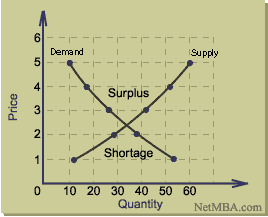
While this formula tell us what we should be charging, economics may dictate otherwise. You see, I seem to remember in my college Economics course, this line graph with two intersecting lines. One line was called supply, the other demand. Supply and Demand (and their neat little graph) show us the price that the market will bear. If the market is flooded with an item, for example 200 pinto beans priced at $1 a bean, and there are only 20 people who are wiling to buy a bean at $1, the seller will sell $20 of beans and have 180 beans left over. The seller wants to sell all 200 beans. 50 people are willing to pay 75 cents for a bean. If the seller sells 50 beans at 75 cents, he has sold $37.50 of beans. He has sold more beans and received more money.

Supply side economics are a little harder to understand in the handmade marketplace where most items are unique. We aren't usually dealing with thousands of items, or even hundreds. Supply and Demand (mostly demand) still plays a role though. If no one wants our product, it still won't sell, but here might be more people who would buy it at a lower price.

This is a place where I'm struggling as an online crafter. I've sold a few things of several types of things. I've sold more at my current price points which are in fact less than wholesale. Unfortunately, at that price, I can't afford to advertise to get more traffic to my shop. The longer it takes me to get a sale, the more times I have to renew my listings, which then adds to the cost of my goods. Should I then raise the price every time I renew? I haven't yet, I keep thinking if it didn't sell at $x, then it surely won't sell at $x.20.

While I haven't solved the pricing problem, I hope I have given you some food for thought! Please chime in with your observations as well.

Thursday, April 19, 2012

A Gardening Metaphor

Having just spent an hour digging out dandelion from the yard, I started wondering why I fight with nature every year over them. They are quite a pretty flower, the greens are even edible. They bloom all summer long. Why do I dutifully dig them out every year? After all, there is a quote at Nick's Garden Center that says "A weed, is just a plant out of place." And for xeriscape gardening using native plants and flowers is how they keep water usage down.


Then I remember the morning glory in my yard, you know, the wild kind, the one that is called field bindweed. The first spring after we moved in, that spring sixteen years ago, I saw morning glories coming up. I had heard that they were bad, and I shouldn't keep them, but they were so pretty.

Unfortunately, by fall, those pretty vines and flowers were climbing up my vegetable garden plants and choking them out. Still, I thought, if I could just confine them to one part of the yard, I could enjoy their beauty without the risk. I'm hearing laughter in the background, I'm sure of it. Those of you who are more experienced than me at gardening know better. Once weeds get established, it's a forever fight. Now every year, I have to pull the morning glory. That still doesn't kill them, they have a web of roots that can go clear across the yard and pop up somewhere else. The only way to truly kill them is with roundup. Pulling them up is just a temporary fix. But roundup is so chemical, and so final, and so easy to spray on the wrong thing.

And then there is the thistle. It's pretty easy to know that one is a weed, it's not that pretty, and it's prickly, some more than others. I think we have three or four varieties in our yard. Did you know it is a floral symbol of Scotland? There is a legend telling how that came about, having to do with the prickles and defense of the kingdom, of course. I suppose I could justify leaving the thistles alone as a perimeter defense mechanism, but I think I'll leave that to the roses.

Did you know that spraying roundup on dandelion and thistle isn't enough? The plant will still go to seed as it is dying, to afflict and torment man for another season. You have to dig it up, put it in the trash, then spray roundup on the leftover root. So much work! 

I feel that somewhere in this experience is a metaphor for life. It's easy to let bad habits take root in our life, sometimes they are so enticing, just like the pretty flowers. Digging them out is a lot of work. Older, more experienced people will tell us to avoid the bad habits to start with, just like the older gardener had told me that morning glory was bad. Young people think the old ones are old fashioned, and judgemental. Really, it's just because they are older, have experienced more in life, either personally, or by the observation of others. 

Young people, like young gardeners, seem to have to experience things for themselves before they will believe what they've been taught. And so, sixteen years later, I'm still fighting the fight with dandelion, morning glory, and thistle. It would be much easier just to let things be, rather than continue the fight. But I don't want my garden to become overwhelmed. I just hope that my children won't take that long to learn the lessons of life.

Wednesday, March 21, 2012

Color Me Wild

As my second Featured Seller, may I present my niece's daughter, Amanda Dulaney. Amanda is the owner of Color Me Wild Jewelry. You can also find her shop on Facebook.  You can contact her directly at 618-751-6505 or by email. These are her words to describe what she does, "I do all types of jewelry, trying to work with just about anything I can. I don't work with plastic. I've done weddings, proms, everyday, church, theme inspired, some are 18th century style. I love the elegant jewelry and a mix of unique pieces as well."


Saturday, November 26, 2011

Quilts From The Stash

I want to teach you how to plan well-designed quilts using the scraps of fabric you already have in your cupboards or closets. You know the fabric I'm talking about, your "stash", that fabric that is too big to throw away, and too small for most projects. Simply said it's your leftovers.

You will notice right away that all of these examples are using squares. For my needs, a 4" square was the perfect size. You might decide that you want squares that are a different size, depending upon the size of your scraps, or not use squares at all. The knowledge gained from these examples can be applied to any type of pieced quilt, any pattern, any shape.

To begin this discussion, I will introduce a new term to you, a term that I made up for my instructional purposes here. The term is "anchor fabric". It's the piece of fabric that you will want to coordinate everything else with. It is the "anchor" of your quilt.  The other term we will use is "coordinating fabric". I'm sure you have heard of that before. Simply said, it is a fabric that is different than the anchor fabric, but still looks good with it. If you are planning to purchase new fabric for a quilt, you can often find coordinating fabrics where someone else has chosen them for you and they will be clustered together on the rack. Since I wanted to use my stash fabric, I learned to look for coordinating fabrics in my stash.

In each of the following examples, the picture on the left is the quilt. The picture on the right is the individual squares, the center square being the anchor fabric, and the others being the coordinating fabrics. You will notice that coordinating fabrics do not necessarily look good with each other, but each one of them looks good with the anchor fabric. The quilt backing is one large piece of one of the coordinating fabrics, which one is dependent upon which I had a piece that large of.
Aqua Bears Baby Quilt
In this example, the square of fabric on the left is the yellow square in the picture. It actually has green dots, not black dots, just like the drum in the bear fabric. The blue stripe and solid blue are the same shade of blue. The pink check is the same color of pink as the bear fabric. The backing is the yellow with green dots.
Blue Bears Baby Quilt
In this example, I had fewer pieces of my anchor fabric, but found more options for my coordinating fabrics. Once again, the yellow in the quilt picture is the same yellow as in the close-up of the coordinating fabrics, and in fact, is the same fabric as the previous example. There is orange in the bear's hat and clothes like the solid orange I used. There is ivy/holly trimmings on bear's hat, thus, the two pieces of green/red leaf look great. The orange/blue plaid works well, as does the blue/white stripe,the bright blue abstract piece and the country blue with white dots. The backing is the blue abstract piece.
Country Bears Baby Quilt
In this example, the yellow print on the left of the squares close-up is the same shade of yellow as the yellow stripe in the anchor fabric. There is red and white in the anchor, so the red/white stripe matches well. The blue square on the right has a "denim" pattern which coordinates well with the bear's pants. The blue stripe with the hearts looks good with anything country, as does the green leafy calico print and the blue/white check. The backing is the red stripe.
Zoo Animal Baby Quilt
With this quilt, I found I didn't have enough pieces that coordinated with my anchor fabric. I had to go buy something! Surprisingly, the anchor fabric was still on the racks with all it's coordinating fabrics around it. The green/blue leafy piece with the elephant on the bottom was one of the coordinating fabrics so I did get some of it. I also bought the many colored dots to the right, but found it on the clearance racks for $1/yard, can't go wrong there, and it still looks good with the anchor. The anchor fabric has quite a lot of peach color to it, hence the peach plaid fabric, and of course the solid blue and solid green pieces are the same shades of blue and green in the anchor fabric. The backing is the many-colored dots fabric.

I bet you've already had your mind wander to your stash, and had several ideas pop into your head, haven't you? My examples are all baby quilts 40" x 40" square which I made for my son's Eagle Scout Project. This is a great size for a baby quilt, lap quilt for the elderly, wall hanging, etc. You could also use more coordinating fabric options for bed size quilts. The sky is the limit (or for me, the "square" is the limit)! And remember, if your stash isn't big enough to pull something together from it, holidays are great times to go to the fabric stores when they have all their clearance fabrics 50% off clearance price, and stock up! So get quilting!