Once again, I am partnering for a giveaway of my shopping bags. This time, Skinny Gene Healthy Mommas has contacted me. Follow this link to enter Skinny Gene Project, follow all the rules, get your entry in by September 16, 2012, 11:59 p.m.
While your at it, check out the Skinny Gene Project, get information about diabetes, and find out how this project can help you. Here is a quote from their site:
The Skinny Gene Project (a division of the J.Moss Foundation), is a 501(c)(3) non-profit organization dedicated to preventing diabetes. We help to educate those who are at-risk; empower them with the resources, tools, and support needed to make healthy lifestyle changes; and teach them how to make the long-term social, environment, and behavioral changes needed to prevent the onset of type 2 diabetes.
Showing posts with label etsy. Show all posts
Thursday, September 6, 2012
Friday, August 31, 2012
Google Your Shop
Having recently read articles from Handmadeology on improving SEO for my shop, on a whim I decided to Google my shop name CalliesCraftCottage, thinking I would see when it was last cached. What I found was so much more! In fact, I totally forgot about when it was last cached. I found 45 pages of information about my shop, yes, 45! Who would have known? Who would have guessed that there was this much information out there? When we talk about Search Engine Optimization, we are usually talking about listings, but Google cares about EVERYTHING. Below, we'll take a look at each of the unique types of information I found, and the order the results came up:
Page 1
1. http://www.etsy.com/shop/CalliesCraftCottage This is the link for my Etsy shop, no surprises there, it should be first on the list of results.
2. http://www.etsy.com/people/CalliesCraftCottage This link takes me directly to my profile page in my Etsy shop.
3. http://calliescraftcottage.blogspot.com/ This link is to my blog about my shop. I feel that is a good placement in the results.
4. https://www.facebook.com/calliescraftcottage This link is my shop's Facebook Page, it should come up early in the results.
5. http://www.smoeye.com/monitor/387394/facebook/www.facebook.com/calliescraftcottage This link is to a Social Media Monitoring Tool with information about my shop's Facebook Page. You can set up an account for more detailed information. I don't know if it would provide more information that I already get from Facebook weekly. I was just surprised it was there!
6. http://tools4etsy.com/Feedback/As-Seller/CalliesCraftCottage This link is to Tools4Etsy, specifically feedback for my shop. It shows a picture of the item sold, and the related feedback from the buyer, and from me as the seller, all in a cute format. Who knew?
7. http://www.etsyonsale.com/shop/CalliesCraftCottage This link is to another app for Etsy sellers. It shows any items that I have currently listed as being "on sale". I don't have anything currently, but I have used it in the past.
8. http://www.etsy.com/treasury/MTA2NDExNjR8NDg4ODk5/looking-through-rose-colored-glass This is link to a treasury I curated. It also shows the most relevant comment right after the listing. Not sure why this treasury is listed so much higher than the others, but possibly because it had the most interesting comments.
9. http://ilzescreations.blogspot.com/2011/08/crafty-mom-of-five.html This link is to a blog where I was a "Featured Seller" about a year ago.
Page 2
10. http://www.handmadespark.com/myspark/calliescraftcottage This link is to HandMade Spark, another selling venue which gives you a mini shop for free, showing the most recent three listings in your Etsy shop. Additional features are available for a fee. I did recently sign up for this one.
11. http://www.pageinsider.com/calliescraftcottage.blogspot.com This link is to PageInsider.Com which shows information about any website (content, traffic info, reviews, coupons, server, web results). It didn't really show much information for my shop. You can however, sign up for an account there. This is also a "Who knew?".
12. http://wikiworldbook.com/global-address-book/Callie-craft This link goes to the WikiWorldBook.com, a global address book, specifically showing results for "Callie-craft". I'm not the only one in the results, I think every Callie in the world is a crafter.
13. http://www.blogger.com/profile/08972560324968152819 This link goes directly to my profile on Blogger.
Page 5
http://www.grocerycouponnetwork.com/community/be-green-giveaway-win-a-set-of-reusable-bags/ This link is to a blog which hosted a giveaway of my shopping bags. The giveaway is over, so page 5 of the results makes sense.
Page 11
http://babygiveaways.blogspot.com/2012/05/lds-etsy-team-giveaway-1-winner-16.html This link is also a blog which hosted a contest and my shopping bags were among the prize items. Again, the giveaway is over, so the listing would be old.
The rest of the results are for other treasuries I have curated, other's blog posts and Facebook posts I have commented on under my shop name, listings in my shop, Etsy team posts I have commented on, and Etsy searches which found my items. Etsy Stats will show you what tags were used to find your items, but I found this interesting because it also shows other items besides yours that show up in the results. The one piece of information I found to be missing is my LinkedIn profile. My profile does say that I am the owner of CalliesCraftCottage, so I would have expected a finding there, maybe it was buried in one of the later pages, I didn't look much past page 11 as it seemed to be only listings and treasuries, and searches.
The "take-away" from this little exercise is that there is so much more out there for the public to see if they want to. I need to be sure all the pieces are consistent, and what I would want the public (potential buyers) to see. I suggest that any other Etsy sellers also Google their shops. You'll be surprised at what you see!
Labels:
blogs,
business,
etsy,
google,
listings,
search engine optimization,
search results,
seo
Tuesday, August 21, 2012
Treasury Feature #6
'Home Sweet Home' by CalliesCraftCottage
Homes can be very different...just depends upon who you are!
| Upcycled Vintage BirdHo... $47.00 | Bird House Cage Birds O... $1.00 | Photograph Philadelphia... $15.00 | Custom House Portrait -... $90.00 |
| mini birdhouse, pyrogra... $30.00 | Red cabin, crimson aban... $20.00 | MAJOLICA BIRDHOUSE WITH... $25.00 | Rustic Butterfly House $38.00 |
| Original -Wedding Card... $95.00 | Custom House Ornament- ... $45.00 | Custom oil painting of ... $85.00 | Dolls' House Miniat... $46.00 |
| Tiny Terrarium Ring wit... $60.00 | Ravenwing Cottage Witch... $1500.00 | Fairy House For Twenty-... $75000.00 | Watercolor Home/House P... $99.00 |
Treasury tool supported by the dog house
Labels:
birdhouse,
etsy,
etsy sellers,
fairy homes,
fine art,
home,
house,
prints,
Treasury
Thursday, August 9, 2012
Shopping Bag Giveaway through Grocery Coupon Network
See these bags? Love these bags? Grocery Coupon Network is hosting a giveaway of these bags! Follow this link, Grocery Coupon Network,
do all the required steps, and they could be yours! Deadline for entry is Sunday August 12, 2012 11:59 p.m. I don't know what time zone that is, so better do it early, in fact, why not do it today? Give a "like" to the GCN Facebook page too!
Labels:
etsy,
etsy freebie,
etsy giveaway,
facebook giveaway,
free bags,
gcn giveaway,
grocery coupon giveaway
Tuesday, June 5, 2012
A Word About Pricing: Economics
Much has been said recently regarding how to properly price our handmade goods in the online marketplace. I find myself wanting to add my "two cents" on the subject. Now, I assure you, I am not an expert in any sense of the word, just an observer.
I'm sure you all know the formula but I've added a few personal tweaks.
Cost Of Goods x 2 + selling fees = Wholesale x 2 + advertising = Retail.
Do you know what each of these terms means? Cost of Goods refers to the actual cost of producing an item, the cost of the raw materials, plus a dollar amount for the time taken to produce an item. (I won't get into the full term of Cost of Goods Sold because that may vary depending on if you are on a cash basis or an accrual basis.)
To put a dollar amount on time, we need to determine how to value our time. This is a really hard part, because most online crafters are homemakers. It's really hard to devote even a whole hour to a project with no interruptions, so calculating true time spent is hard. I've heard $10 an hour as a minimum target to shoot for in figuring out our cost of time. At $10 an hour, you gotta love what you do!
Selling Fees refers to the listing, and selling fees of your online marketplace, as well as any payment processing fees. These need to be worked into the formula to be sure those costs are covered.
Wholesale is the sale of goods to anyone who is not the final customer, but for these purposes, it is the price which we should charge for wholesale sales. The wholesaler, being responsible for making the end sale, will want to be able to make a profit in reselling our merchandise, so the lower price allows for that. Another way to look at it is "selling in bulk". The wholesaler usually buys a large lot of the same item, bulk discounts are normal in commerce.
Advertising dollars is what sellers spend to get people to come into the store and look, or for online, click on our website, or search for our product.
Retail is the sale of goods to the final customer, or for our purposes, the price we will offer our customers. Stated retail prices are high enough to allow for sales, coupons and other marketing strategies while still allowing the retailer to cover the cost he paid for the item. Don't forget, retailers usually are paying employees and rent as well.
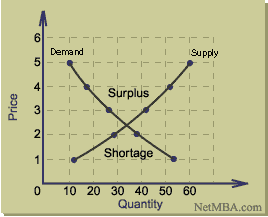
While this formula tell us what we should be charging, economics may dictate otherwise. You see, I seem to remember in my college Economics course, this line graph with two intersecting lines. One line was called supply, the other demand. Supply and Demand (and their neat little graph) show us the price that the market will bear. If the market is flooded with an item, for example 200 pinto beans priced at $1 a bean, and there are only 20 people who are wiling to buy a bean at $1, the seller will sell $20 of beans and have 180 beans left over. The seller wants to sell all 200 beans. 50 people are willing to pay 75 cents for a bean. If the seller sells 50 beans at 75 cents, he has sold $37.50 of beans. He has sold more beans and received more money.
Supply side economics are a little harder to understand in the handmade marketplace where most items are unique. We aren't usually dealing with thousands of items, or even hundreds. Supply and Demand (mostly demand) still plays a role though. If no one wants our product, it still won't sell, but here might be more people who would buy it at a lower price.
This is a place where I'm struggling as an online crafter. I've sold a few things of several types of things. I've sold more at my current price points which are in fact less than wholesale. Unfortunately, at that price, I can't afford to advertise to get more traffic to my shop. The longer it takes me to get a sale, the more times I have to renew my listings, which then adds to the cost of my goods. Should I then raise the price every time I renew? I haven't yet, I keep thinking if it didn't sell at $x, then it surely won't sell at $x.20.
While I haven't solved the pricing problem, I hope I have given you some food for thought! Please chime in with your observations as well.
I'm sure you all know the formula but I've added a few personal tweaks.
Cost Of Goods x 2 + selling fees = Wholesale x 2 + advertising = Retail.
Do you know what each of these terms means? Cost of Goods refers to the actual cost of producing an item, the cost of the raw materials, plus a dollar amount for the time taken to produce an item. (I won't get into the full term of Cost of Goods Sold because that may vary depending on if you are on a cash basis or an accrual basis.)
To put a dollar amount on time, we need to determine how to value our time. This is a really hard part, because most online crafters are homemakers. It's really hard to devote even a whole hour to a project with no interruptions, so calculating true time spent is hard. I've heard $10 an hour as a minimum target to shoot for in figuring out our cost of time. At $10 an hour, you gotta love what you do!
Selling Fees refers to the listing, and selling fees of your online marketplace, as well as any payment processing fees. These need to be worked into the formula to be sure those costs are covered.
Wholesale is the sale of goods to anyone who is not the final customer, but for these purposes, it is the price which we should charge for wholesale sales. The wholesaler, being responsible for making the end sale, will want to be able to make a profit in reselling our merchandise, so the lower price allows for that. Another way to look at it is "selling in bulk". The wholesaler usually buys a large lot of the same item, bulk discounts are normal in commerce.
Advertising dollars is what sellers spend to get people to come into the store and look, or for online, click on our website, or search for our product.
Retail is the sale of goods to the final customer, or for our purposes, the price we will offer our customers. Stated retail prices are high enough to allow for sales, coupons and other marketing strategies while still allowing the retailer to cover the cost he paid for the item. Don't forget, retailers usually are paying employees and rent as well.
While this formula tell us what we should be charging, economics may dictate otherwise. You see, I seem to remember in my college Economics course, this line graph with two intersecting lines. One line was called supply, the other demand. Supply and Demand (and their neat little graph) show us the price that the market will bear. If the market is flooded with an item, for example 200 pinto beans priced at $1 a bean, and there are only 20 people who are wiling to buy a bean at $1, the seller will sell $20 of beans and have 180 beans left over. The seller wants to sell all 200 beans. 50 people are willing to pay 75 cents for a bean. If the seller sells 50 beans at 75 cents, he has sold $37.50 of beans. He has sold more beans and received more money.
Supply side economics are a little harder to understand in the handmade marketplace where most items are unique. We aren't usually dealing with thousands of items, or even hundreds. Supply and Demand (mostly demand) still plays a role though. If no one wants our product, it still won't sell, but here might be more people who would buy it at a lower price.
This is a place where I'm struggling as an online crafter. I've sold a few things of several types of things. I've sold more at my current price points which are in fact less than wholesale. Unfortunately, at that price, I can't afford to advertise to get more traffic to my shop. The longer it takes me to get a sale, the more times I have to renew my listings, which then adds to the cost of my goods. Should I then raise the price every time I renew? I haven't yet, I keep thinking if it didn't sell at $x, then it surely won't sell at $x.20.
While I haven't solved the pricing problem, I hope I have given you some food for thought! Please chime in with your observations as well.
Tuesday, August 23, 2011
Relevancy...The New Buzz Word
As you know, I have a craft shop on Etsy called CalliesCraftCottage. Recently, Etsy has changed how they do their default search. To really understand why this is such a big deal, you need to understand how searches used to work.
The Old Search
The old search default used something called "Most Recent", meaning most recently listed. If I searched for the terms "pink glass", for example, at the top of the list I would find the item that was most recently listed, or relisted, that was made from pink glass. This wasn't a bad way to run the search, but it assumed that the most important item to you, the buyer, was the one most recently listed. When putting together a treasury, sometimes I would scroll through pages and pages of items just to find something that wasn't listed "today" because I purposely wanted to find something that had been listed a little longer. I suppose I'm just contrary that way sometimes.
Having come from an accounting background, that type of search makes me think of a LIFO, or "last in, first out" type of inventory management, which from a search standpoint makes no sense at all. It only makes any sense whatsoever if all inventory items are indistinguishable from each other. In the handmade craft world, it is totally senseless, and I for one am very glad that Etsy has changed for the better.
The "Most Recent" type of default search contributed to "renew fever", that contagious little bug that made us all want to keep our products at the top of the lists, rather than buried down in the pages and pages of stuff. A listing stays active for four months before it dissappears or must be renewed, but you can renew at any time. To stay at the top of the searches, sellers would renew often, sometimes daily.
The New Search
The new default search uses something called "Most Relevant". Relevancy is defined as the relation of something to the matter at hand. So, today I searched for "pink glass" and search returned 65,272 items. The first ten things shown all said "pink glass" somewhere in their titles, but their listings were really varied in age: 8/5/11, 8/16/11, 8/21/11, 8/24,11/ 7/25/11, 8/10/11, 7 hours ago, 8/1/11, 57 minutes ago, 8/7/11, respectively. As a seller, I find that very encouraging. It means I don't have to renew my listings before they are due to be renewed, just to get them seen. I just have to title and tag them with words that are meaningful to a buyer.
Is "relevancy", therefore, a new strategy? I think not. We should have been using titles and tags that were relevant to start with. Does it mean sellers need to do business differently? Maybe. We need to look at our marketing strategies with new eyes. Those who were relying heavily on renewing daily to be seen can save their pennies to be used in different ways for their businesses. Those who, like me, didn't feel successful enough to waste our pennies on renewing, just might be seeing an increase in shop traffic, I know I am. Is it because of "relevancy", or because I joined a new team, or because I started a blog? I won't ever have the answer to that question, but I'm just grateful that for whatever serendipitous reason, my shop has more traffic. Now I just hope that traffic will translate that into more sales.
The Old Search
The old search default used something called "Most Recent", meaning most recently listed. If I searched for the terms "pink glass", for example, at the top of the list I would find the item that was most recently listed, or relisted, that was made from pink glass. This wasn't a bad way to run the search, but it assumed that the most important item to you, the buyer, was the one most recently listed. When putting together a treasury, sometimes I would scroll through pages and pages of items just to find something that wasn't listed "today" because I purposely wanted to find something that had been listed a little longer. I suppose I'm just contrary that way sometimes.
Having come from an accounting background, that type of search makes me think of a LIFO, or "last in, first out" type of inventory management, which from a search standpoint makes no sense at all. It only makes any sense whatsoever if all inventory items are indistinguishable from each other. In the handmade craft world, it is totally senseless, and I for one am very glad that Etsy has changed for the better.
The "Most Recent" type of default search contributed to "renew fever", that contagious little bug that made us all want to keep our products at the top of the lists, rather than buried down in the pages and pages of stuff. A listing stays active for four months before it dissappears or must be renewed, but you can renew at any time. To stay at the top of the searches, sellers would renew often, sometimes daily.
The New Search
The new default search uses something called "Most Relevant". Relevancy is defined as the relation of something to the matter at hand. So, today I searched for "pink glass" and search returned 65,272 items. The first ten things shown all said "pink glass" somewhere in their titles, but their listings were really varied in age: 8/5/11, 8/16/11, 8/21/11, 8/24,11/ 7/25/11, 8/10/11, 7 hours ago, 8/1/11, 57 minutes ago, 8/7/11, respectively. As a seller, I find that very encouraging. It means I don't have to renew my listings before they are due to be renewed, just to get them seen. I just have to title and tag them with words that are meaningful to a buyer.
Is "relevancy", therefore, a new strategy? I think not. We should have been using titles and tags that were relevant to start with. Does it mean sellers need to do business differently? Maybe. We need to look at our marketing strategies with new eyes. Those who were relying heavily on renewing daily to be seen can save their pennies to be used in different ways for their businesses. Those who, like me, didn't feel successful enough to waste our pennies on renewing, just might be seeing an increase in shop traffic, I know I am. Is it because of "relevancy", or because I joined a new team, or because I started a blog? I won't ever have the answer to that question, but I'm just grateful that for whatever serendipitous reason, my shop has more traffic. Now I just hope that traffic will translate that into more sales.
Labels:
business,
calliescraftcottage,
craft shops,
etsy,
relevancy,
search
Saturday, August 13, 2011
IlzesCreations


It is with great pleasure and humility that I present IlzesCreations as my first featured artisan. Ilze is from Riga, Latvia and recently featured me in her blog. She uses a variety of techniques for a variety of crafts. Ilze makes hats, socks, shawls, and jewelry using felting, embroidery, sewing, crochet, and knitting techniques. She opened her shop in April of 2011, and it has matured greatly just in the short time since I first met her. Ilze is running a 20% off sale through the end of August in her Etsy shop, the code is ICSALE.
Subscribe to:
Posts (Atom)